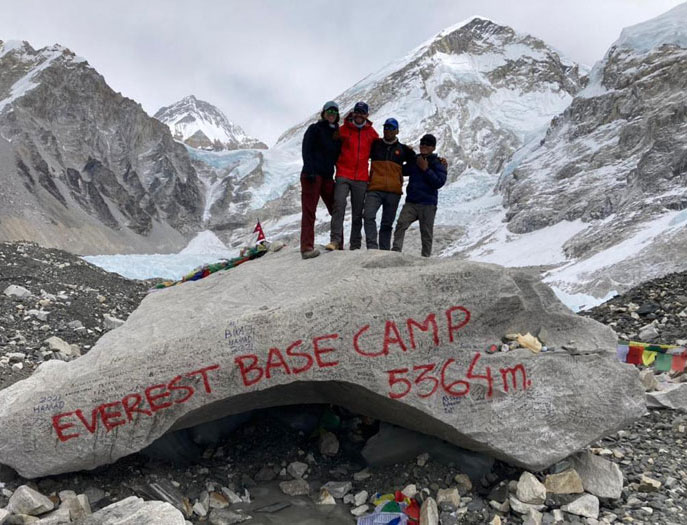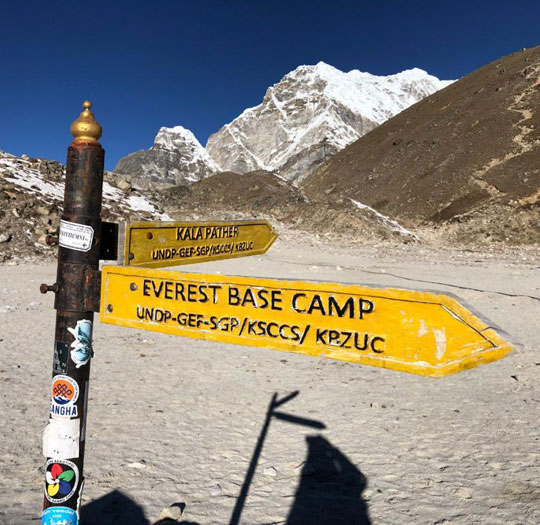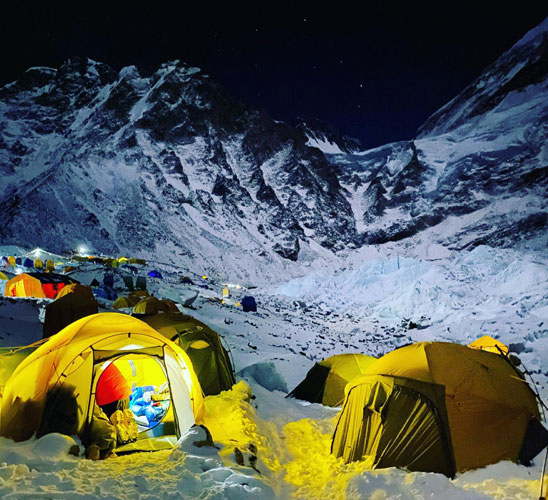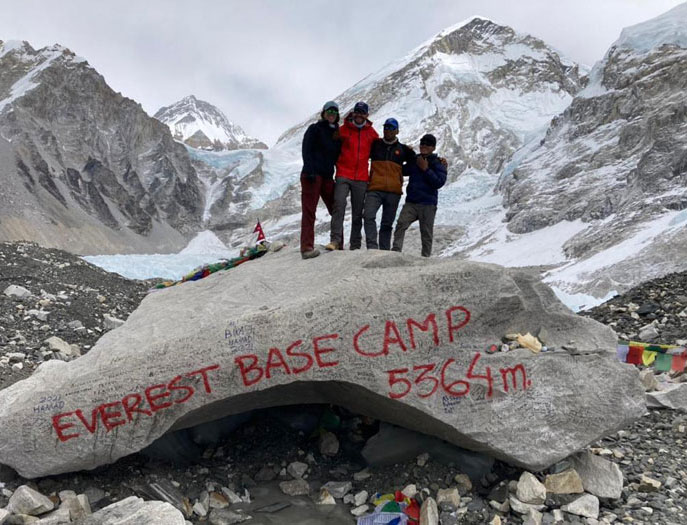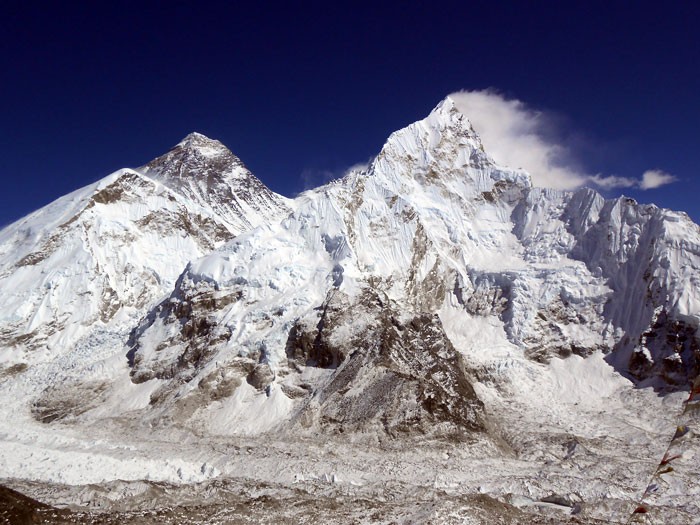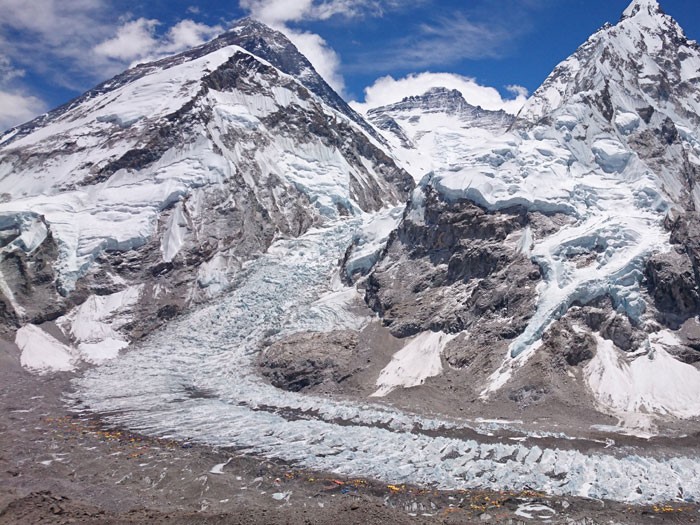

Trek to world's most famous basecamp. Enjoy a beautiful walk to Everest with our friendly team in January, April, November and December . Trips led and organized by Dan Mazur, 12 time Everest Expedition leader.


Dates 2026 and 2027 3 January to 19 January | 7 February to 23 February 7 March to 23 March | 8 April to 24 April & 20 April to 6 May |. 1 November to 17 November 17 Days in Nepal (Other dates available throughout the year. Call for more info) Optional Island Peak add on


Christmas and New Year EBC trek dates : 16 December 2025 to 2 January 2026. Optional 4 day Island Peak add-on


Full Service Cost: $2,850, £2,150, €2,550. (fixed in USD)


Recent News: Please click here to view news of our recent trek. . Click Here is what people are saying.


Please contact us now to book: info@summitclimb.com 


Trek, Walk, Hike To Everest Base Camp Nepal

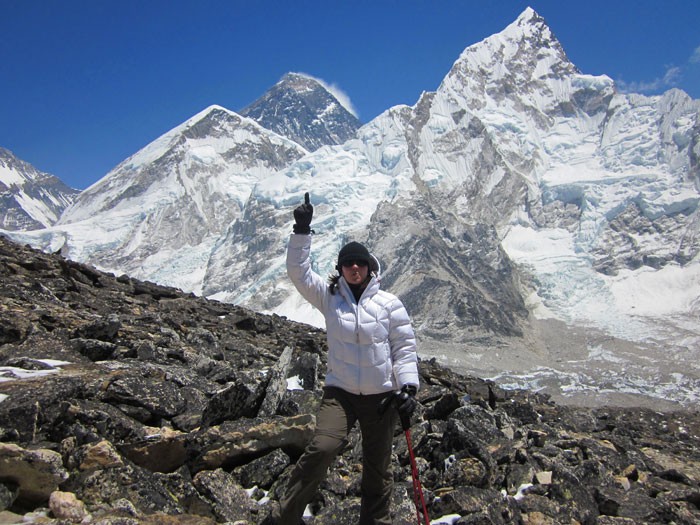
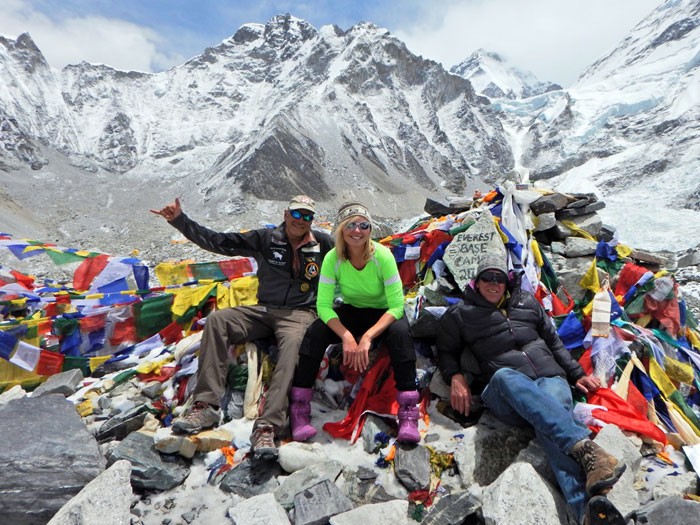
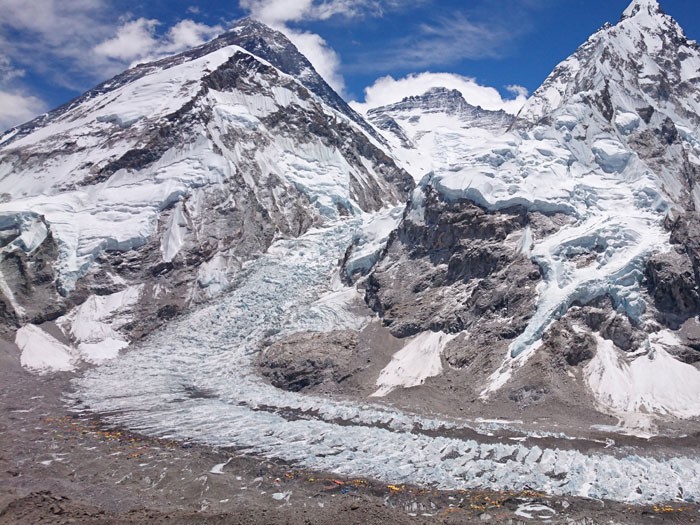
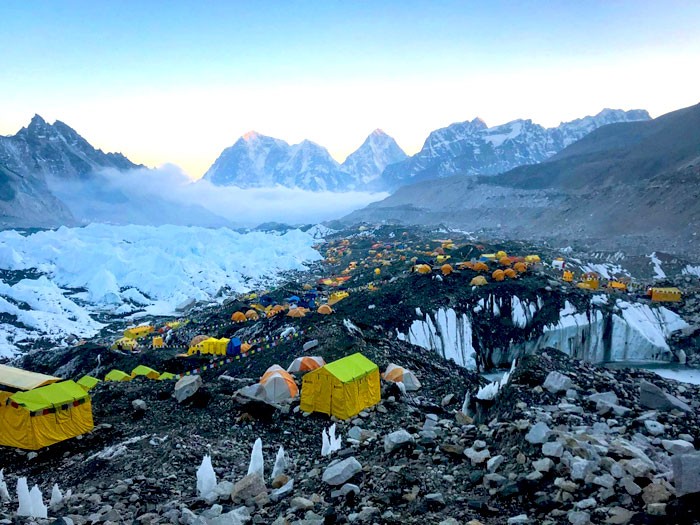
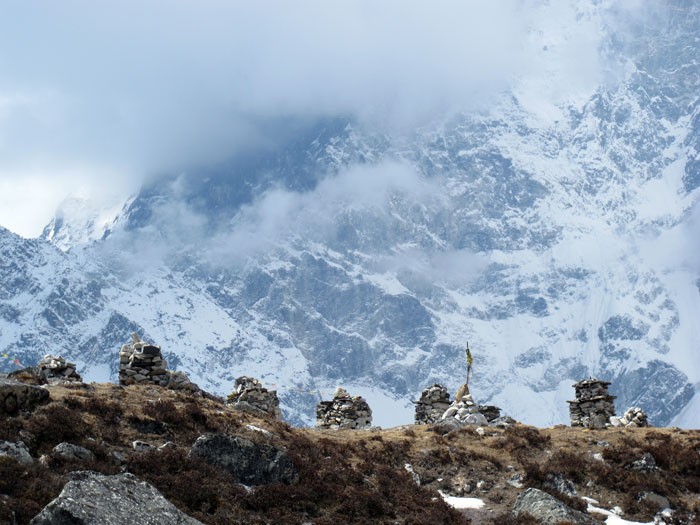
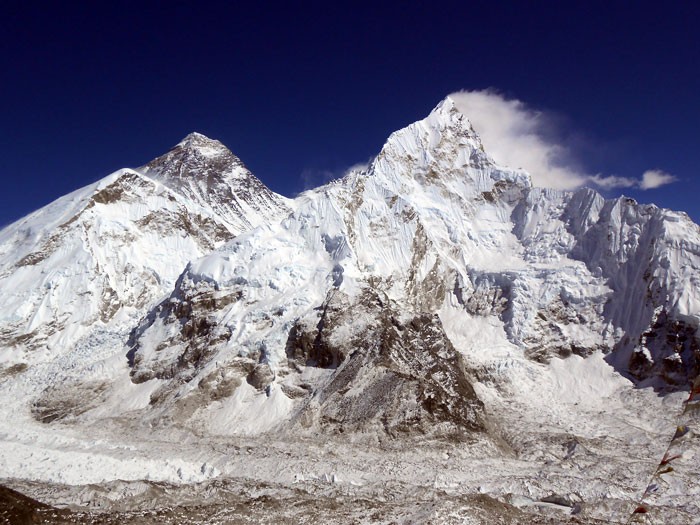
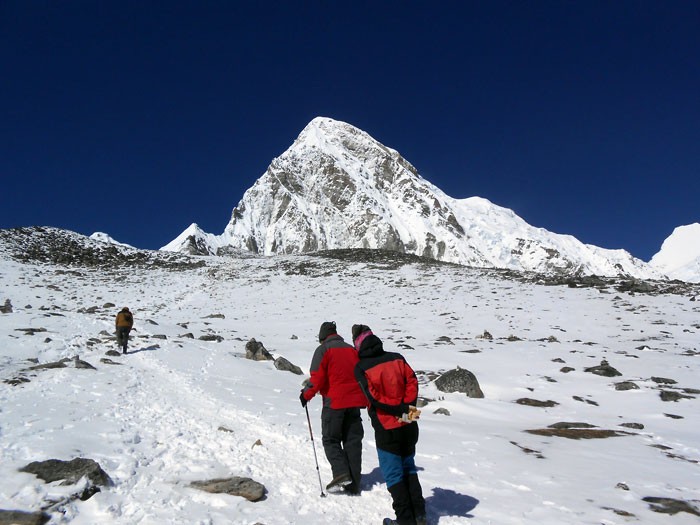
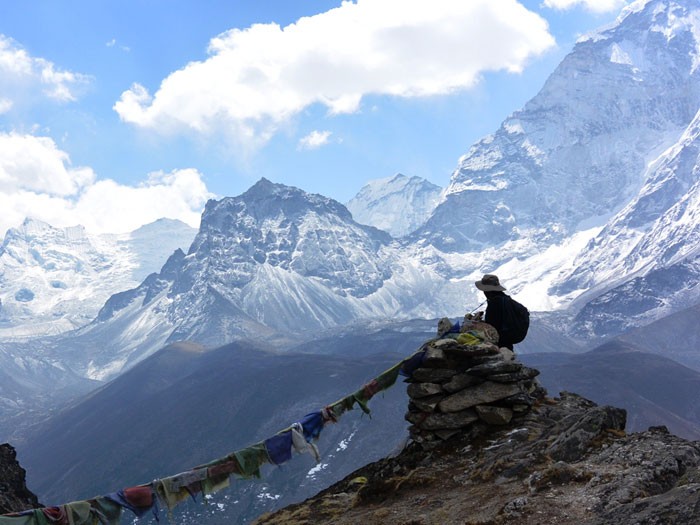
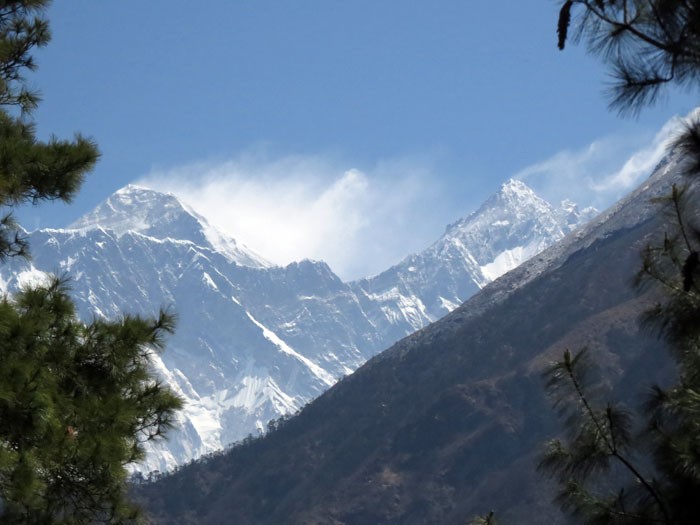
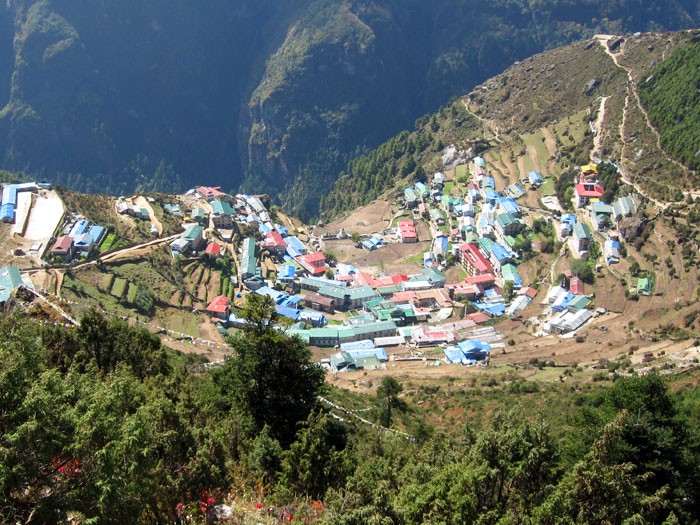
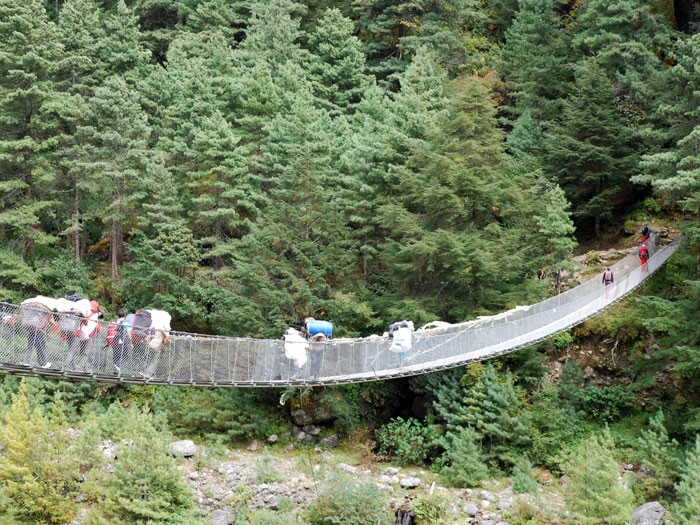
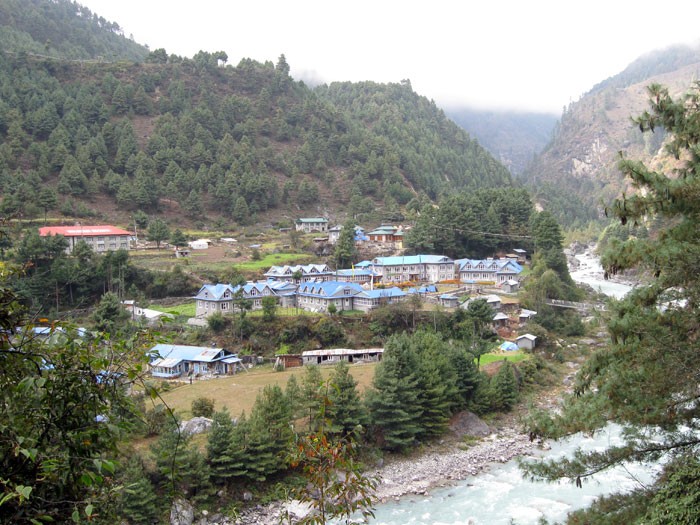
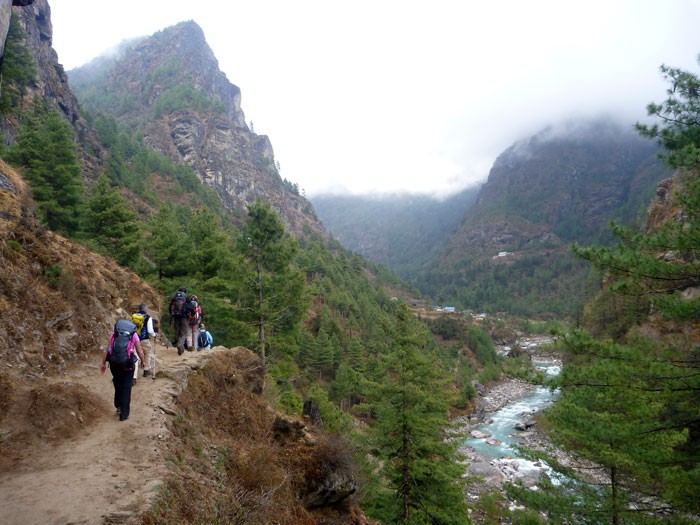
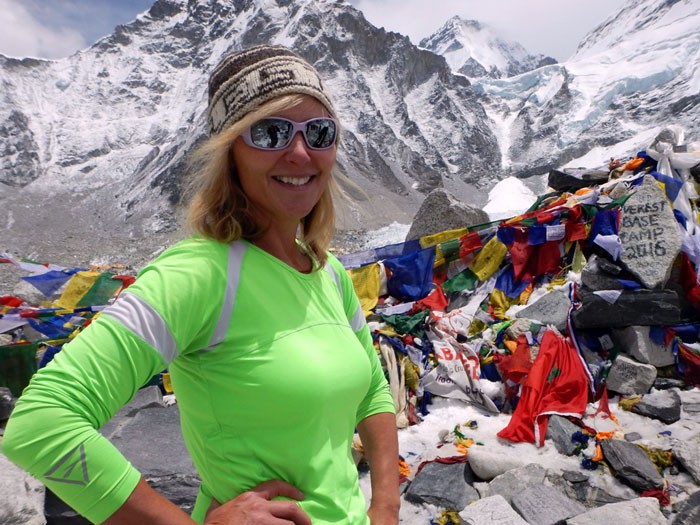
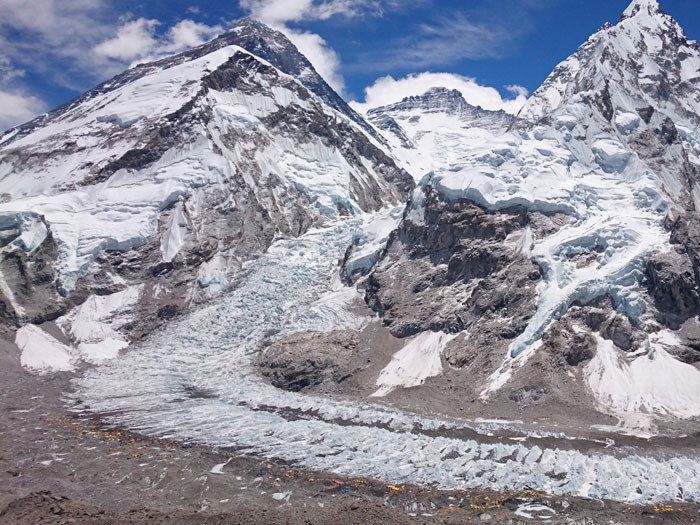
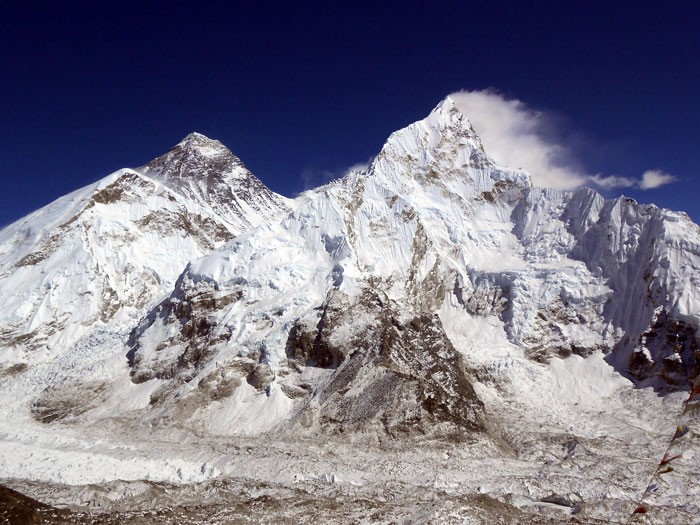
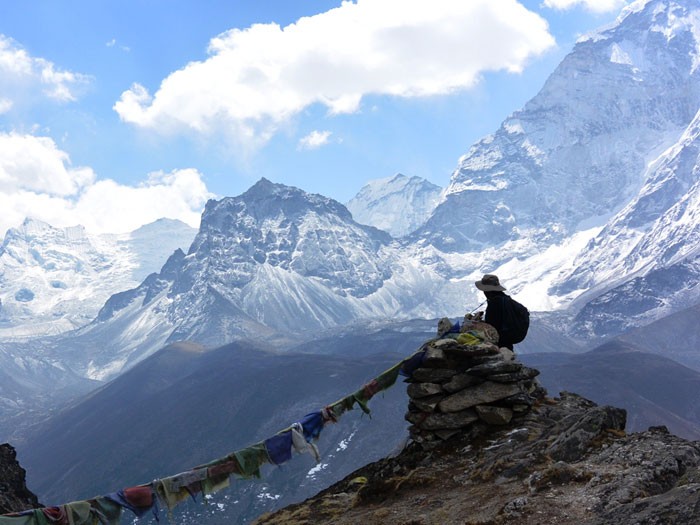
Mt. Everest was first climbed in 1953 by Hillary and Tenzing. Their base camp was at GorakShep which we will visit along our adventure. Our trek to the base of the highest mountain in the world allows you to enjoy the incredible beauty of Nepal and walk to a very high altitude on good snow-free paths, providing spectacular views of Everest and the surrounding Himalaya giants. The trip includes a day hike to the top of Kala Patthar; where some of the most famous pictures of Everest have been taken.


Everest Base Camp Video by Mario H.


Everest Base Camp Trek FAQs
The Everest base camp trek is the most famous trek in the world to the world’s most famous base camp. This trek is in a class of its own and worth it, because of several factors:
  •  Sir Edmund Hillary and Tenzing Norgay Sherpa climbed Mount Everest in 1953 and they used this route to reach Everest Base Camp (EBC). Thus, EBC trekkers are literally “following in the footsteps” of the greats: Hillary and Tenzing.
  •  EBC is the Original Trek. The word “Trek” was popularized by British Army Nepal Gurkha Regiment Colonel James Roberts in the late 1950s when he envisioned that foreign travelers would enjoy walking through picturesque farming villages and sleeping in the comfortable stone homes of local Sherpa families, as the tourists walked to the first ascent base camp at the foot of Mt Everest. Since then, the trek has become incredibly popular and the villages and accommodations along the route have developed to a high standard.
  •  No Other Trek in the World Can Offer This Ultimate Destination: The world’s most iconic basecamp at our Earth’s Highest Point
  • Friendly People. Nepalese people are very warm and friendly, and the Interesting Sherpas who Live in the Everest Region have a fascinating culture and society, so well adapted to the Khumbu Everest Region, and they are especially grateful for your visit and are comfortable being around foreign people. In fact, many Sherpas have relatives living, working and going to school in other countries.
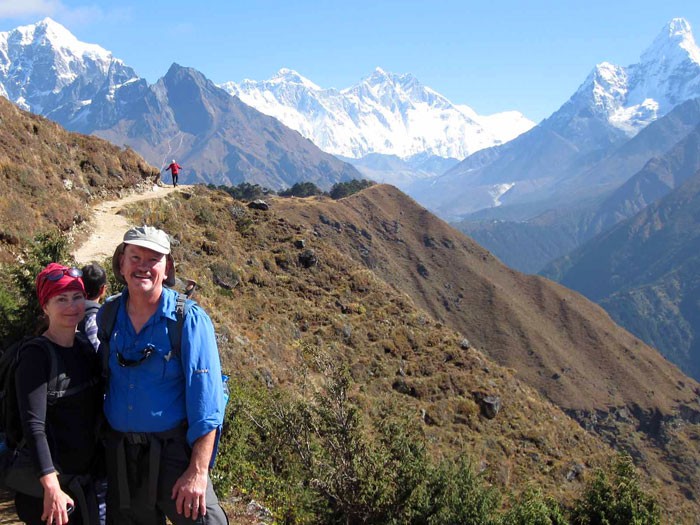
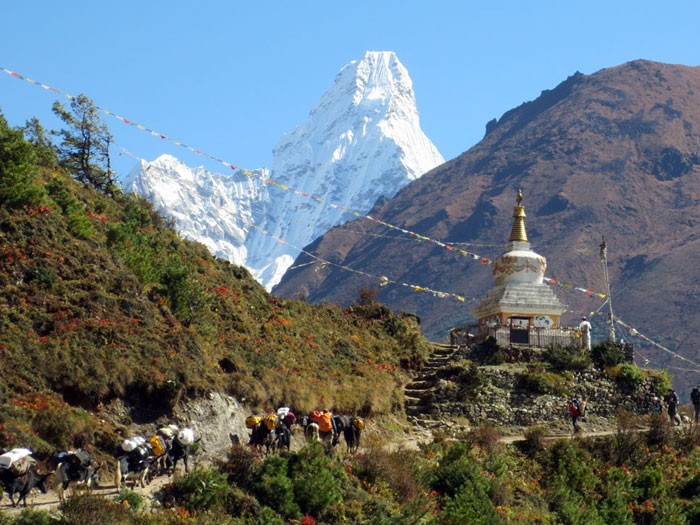
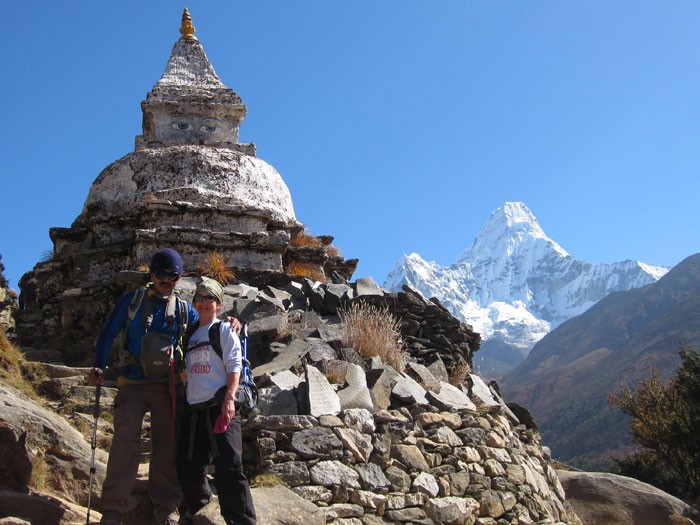
  • Amazing Famous Mountains Along the Trek. Not only can you see Everest, but many other stunning mountains like Ama Dablam, Lhotse, Thamserku, Tawoche, Pumori, Nuptse, and so many others. There really are few other spots in the world to see this amount of peaks in such a short time.
You can do this trek at any time, 12 months per year. We offer it in April, November, and December.
Nepalese Visa’s are offered on-arrival at Kathmandu International Airport. It is not necessary to pre-arrange, just show up at the Kathmandu Airport and pay $100
It's only 17 days, so the trek can easily fit inside three weeks of vacation time, with room to spare.  
Men and women and girls and boys of any age who like to walk and visit fun-friendly mountain destinations will enjoy this trek.
Well, first of all, please bring the normal comfortable clothing and shoes/sandals you would wear in town. Then, please pack your trekking pants, trekking shirts, changes of underwear, trekking socks, undershirts, thermal shirts, and thermal long underwear. Be sure to bring your warm polar fleece jacket and a warm hat. If you feel that your legs become cold easily, please also bring polar fleece trousers too. Please do bring a goretex-type wind/waterproof jacket, and goretex-type wind/waterproof trousers are also very good to have. Bring warm gloves. Don’t forget your sun hat, bandana, or buff. If you have a thick warm-down jacket with a hood, please bring it. If you don’t, you may want to rent/hire or purchase one in Kathmandu, they are rather inexpensive and very good to have. You will need a sleeping bag which is good to minus -20. Again these are inexpensive to rent or purchase. Since you are staying in teahouses and sleeping in their beds, you won’t need a mattress. But a nice warm sleeping bag is good to have, as teahouse bedrooms are not heated. Other trekking items include your personal medicines, sun cream, lip balm, and a water bottle. Good sunglasses are important, as is a good headtorch. You will be able to leave a bag of personal belongings in our locked office store room in Kathmandu.  
Yes, SummitClimb provide hot shower during the trek without paying extra charge.
Nowadays our Sherpa hosts have learned that foreigners enjoy everything from fine luxury hotels with ensuite bathrooms, all of the way down to simple dormitories, or even lovely glassed-in dining rooms, hot showers, or what about the most basic campgrounds, barbershops, spas, saunas, and every type of accommodation you could imagine.
You should be able to walk up and downhill for between 1 and 6 hours, with plenty of tea breaks and meal stops. The trails are generally wide, well-maintained, and mostly of a gentle gradient. Sometimes there are stone stairways, which are quite beautifully built.
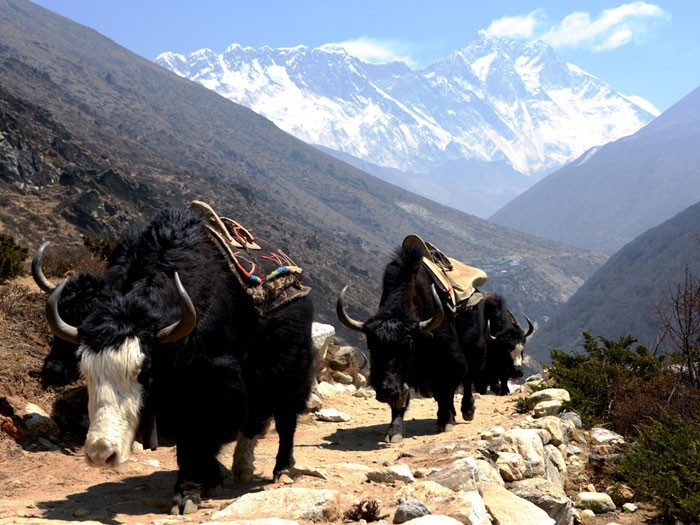
You will not be carrying a large backpack on the trek. All of your heavy things will be carried by yaks and porters. We suggest you carry a small 30-liter day pack, with a water bottle, jacket, camera, warm hat, suncream, etcetera. The weight should be 2 kilos / 5 pounds or less.
Sometimes there is snow in Everest Base Camp, but during the entire trek below Everest Base Camp, it is rare to encounter any snow on the path.
For trekking shoes, we highly recommend a lightweight trekking shoe with good support and comfort which is waterproof and breathable. There are some good lightweight trekking shoes on the market that are a mixture of leather and Goretex and should do nicely.
In April, the weather is cool and pleasant, with occasional cloudy days when there could be snow flurries. It may be cool at night and it usually does not rain. In November, we expect sunny dry days with cool nights. Generally, the weather is very good in November, with few cloudy days.
The leader will be Dan Mazur, with more than 20 EBC treks and 12 Successful Everest expeditions. Also, the trek will be led by experienced Sherpa trekking guides, who are a lot of fun and a real joy to be around. Many of our Sherpa guides have climbed Everest multiple times and have lovely stories to tell.
No, it’s not necessary. Our Western guides will communicate in the English language.
Yes, our staff will be glad to wash your clothing at any time.
Throughout the trek, in all hotels, lodges, and restaurants there are toilets with water.
Four nights at the Harati Hotel are included in your trek fee i.e. two nights at the beginning of your trek and two nights at the end. Most of our guests stay happily at the Harati Hotel, a clean, friendly, hot water hotel with good rooms, a nice lobby, and a delicious breakfast located in the Kathmandu tourist district known as Thamel.
Thamel has more than 100 outdoor equipment shops and lots of nice restaurants, cafes, shops, pubs, and souvenir shops. You can walk everywhere in Thamel. It won’t be necessary to use a taxi inside Thamel. Our leaders and staff will come to your hotel to look at the clothing, shoes, and equipment you have brought, and then they will take you shopping in equipment shops to purchase and rent/hire everything you might need.
Yes, but we suggest you go with a guide for your safety.
Yes, WIFI is available in Everest base camp.
The permit cost of EBC 
  • Tims cart -$20
  • National park – $33
  • Pasalng lamu -$20
In Lodges and tea houses, we can charge electronic devices.

Everest Base Camp Trek Cost

Our full-service expedition includes:

What is not included?

  • International flights to/from Kathmandu
  • Mountain climbing rescue and travel insurance
  • Personal climbing equipment and clothing
  • Gratuities for staff
  • Nepalese visa

Everest Base Camp Trek FAQs
The Everest base camp trek is the most famous trek in the world to the world’s most famous base camp. This trek is in a class of its own and worth it, because of several factors:
  •  Sir Edmund Hillary and Tenzing Norgay Sherpa climbed Mount Everest in 1953 and they used this route to reach Everest Base Camp (EBC). Thus, EBC trekkers are literally “following in the footsteps” of the greats: Hillary and Tenzing.
  •  EBC is the Original Trek. The word “Trek” was popularized by British Army Nepal Gurkha Regiment Colonel James Roberts in the late 1950s when he envisioned that foreign travelers would enjoy walking through picturesque farming villages and sleeping in the comfortable stone homes of local Sherpa families, as the tourists walked to the first ascent base camp at the foot of Mt Everest. Since then, the trek has become incredibly popular and the villages and accommodations along the route have developed to a high standard.
  •  No Other Trek in the World Can Offer This Ultimate Destination: The world’s most iconic basecamp at our Earth’s Highest Point
  • Friendly People. Nepalese people are very warm and friendly, and the Interesting Sherpas who Live in the Everest Region have a fascinating culture and society, so well adapted to the Khumbu Everest Region, and they are especially grateful for your visit and are comfortable being around foreign people. In fact, many Sherpas have relatives living, working and going to school in other countries.
  • Amazing Famous Mountains Along the Trek. Not only can you see Everest, but many other stunning mountains like Ama Dablam, Lhotse, Thamserku, Tawoche, Pumori, Nuptse, and so many others. There really are few other spots in the world to see this amount of peaks in such a short time.
You can do this trek at any time, 12 months per year. We offer it in April, November, and December.
Nepalese Visa’s are offered on-arrival at Kathmandu International Airport. It is not necessary to pre-arrange, just show up at the Kathmandu Airport and pay $100
It's only 17 days, so the trek can easily fit inside three weeks of vacation time, with room to spare.  
Men and women and girls and boys of any age who like to walk and visit fun-friendly mountain destinations will enjoy this trek.
Well, first of all, please bring the normal comfortable clothing and shoes/sandals you would wear in town. Then, please pack your trekking pants, trekking shirts, changes of underwear, trekking socks, undershirts, thermal shirts, and thermal long underwear. Be sure to bring your warm polar fleece jacket and a warm hat. If you feel that your legs become cold easily, please also bring polar fleece trousers too. Please do bring a goretex-type wind/waterproof jacket, and goretex-type wind/waterproof trousers are also very good to have. Bring warm gloves. Don’t forget your sun hat, bandana, or buff. If you have a thick warm-down jacket with a hood, please bring it. If you don’t, you may want to rent/hire or purchase one in Kathmandu, they are rather inexpensive and very good to have. You will need a sleeping bag which is good to minus -20. Again these are inexpensive to rent or purchase. Since you are staying in teahouses and sleeping in their beds, you won’t need a mattress. But a nice warm sleeping bag is good to have, as teahouse bedrooms are not heated. Other trekking items include your personal medicines, sun cream, lip balm, and a water bottle. Good sunglasses are important, as is a good headtorch. You will be able to leave a bag of personal belongings in our locked office store room in Kathmandu.  
Yes, SummitClimb provide hot shower during the trek without paying extra charge.
Nowadays our Sherpa hosts have learned that foreigners enjoy everything from fine luxury hotels with ensuite bathrooms, all of the way down to simple dormitories, or even lovely glassed-in dining rooms, hot showers, or what about the most basic campgrounds, barbershops, spas, saunas, and every type of accommodation you could imagine.
You should be able to walk up and downhill for between 1 and 6 hours, with plenty of tea breaks and meal stops. The trails are generally wide, well-maintained, and mostly of a gentle gradient. Sometimes there are stone stairways, which are quite beautifully built.
You will not be carrying a large backpack on the trek. All of your heavy things will be carried by yaks and porters. We suggest you carry a small 30-liter day pack, with a water bottle, jacket, camera, warm hat, suncream, etcetera. The weight should be 2 kilos / 5 pounds or less.
Sometimes there is snow in Everest Base Camp, but during the entire trek below Everest Base Camp, it is rare to encounter any snow on the path.
For trekking shoes, we highly recommend a lightweight trekking shoe with good support and comfort which is waterproof and breathable. There are some good lightweight trekking shoes on the market that are a mixture of leather and Goretex and should do nicely.
In April, the weather is cool and pleasant, with occasional cloudy days when there could be snow flurries. It may be cool at night and it usually does not rain. In November, we expect sunny dry days with cool nights. Generally, the weather is very good in November, with few cloudy days.
The leader will be Dan Mazur, with more than 20 EBC treks and 12 Successful Everest expeditions. Also, the trek will be led by experienced Sherpa trekking guides, who are a lot of fun and a real joy to be around. Many of our Sherpa guides have climbed Everest multiple times and have lovely stories to tell.
No, it’s not necessary. Our Western guides will communicate in the English language.
Yes, our staff will be glad to wash your clothing at any time.
Throughout the trek, in all hotels, lodges, and restaurants there are toilets with water.
Four nights at the Harati Hotel are included in your trek fee i.e. two nights at the beginning of your trek and two nights at the end. Most of our guests stay happily at the Harati Hotel, a clean, friendly, hot water hotel with good rooms, a nice lobby, and a delicious breakfast located in the Kathmandu tourist district known as Thamel.
Thamel has more than 100 outdoor equipment shops and lots of nice restaurants, cafes, shops, pubs, and souvenir shops. You can walk everywhere in Thamel. It won’t be necessary to use a taxi inside Thamel. Our leaders and staff will come to your hotel to look at the clothing, shoes, and equipment you have brought, and then they will take you shopping in equipment shops to purchase and rent/hire everything you might need.
Yes, but we suggest you go with a guide for your safety.
Yes, WIFI is available in Everest base camp.
The permit cost of EBC 
  • Tims cart -$20
  • National park – $33
  • Pasalng lamu -$20
In Lodges and tea houses, we can charge electronic devices.

Everest Base Camp Trek Itinerary

  1. 1) Arrive in Kathmandu
  2. 2) Orientation
  3. 3) Fly from Kathmandu to Lukla 2,840 meters/9,318 feet. Trek to Phakding, where we stay at a teahouse, 2650 meters/8,694 feet.
  4. 4) Walk to Namche Bazaar 3,440 meters/11,286 feet.
  5. 5) Rest, acclimate, and relax in Namche Bazaar.
  6. 6) Trek to Pangboche, 3,985 meters / 13,074 foot.
  7. 7) Walk along to the village of Dingboche, 4,410 meters / 14,469 feet.
  8. 8) Rest in Dingboche.
  9. 9) Walk to the village Lobuche, 4,930 meters/16,175 feet.
  10. 10) Walk to GorakShep, at 5,160 meters/16,929 feet for lunch, then trek up Kala Patar, 5,545 meters/18,192 feet.
  11. 11) Walk up to Everest basecamp, which lies atop the Khumbu glacier at 5,300 metres/17,388 feet. Return to GorakShep.
  12. 12) Walk to Pheriche.
  13. 13) Walk back to Namche Bazaar.
  14. 14) Walk to Lukla.
  15. 15) Return flight to Kathmandu.
  16. 16) Extra day of rest and celebration in Kathmandu.
  17. 17) Flight home.
Everest Base Camp Trek FAQs
The Everest base camp trek is the most famous trek in the world to the world’s most famous base camp. This trek is in a class of its own and worth it, because of several factors:
  •  Sir Edmund Hillary and Tenzing Norgay Sherpa climbed Mount Everest in 1953 and they used this route to reach Everest Base Camp (EBC). Thus, EBC trekkers are literally “following in the footsteps” of the greats: Hillary and Tenzing.
  •  EBC is the Original Trek. The word “Trek” was popularized by British Army Nepal Gurkha Regiment Colonel James Roberts in the late 1950s when he envisioned that foreign travelers would enjoy walking through picturesque farming villages and sleeping in the comfortable stone homes of local Sherpa families, as the tourists walked to the first ascent base camp at the foot of Mt Everest. Since then, the trek has become incredibly popular and the villages and accommodations along the route have developed to a high standard.
  •  No Other Trek in the World Can Offer This Ultimate Destination: The world’s most iconic basecamp at our Earth’s Highest Point
  • Friendly People. Nepalese people are very warm and friendly, and the Interesting Sherpas who Live in the Everest Region have a fascinating culture and society, so well adapted to the Khumbu Everest Region, and they are especially grateful for your visit and are comfortable being around foreign people. In fact, many Sherpas have relatives living, working and going to school in other countries.
  • Amazing Famous Mountains Along the Trek. Not only can you see Everest, but many other stunning mountains like Ama Dablam, Lhotse, Thamserku, Tawoche, Pumori, Nuptse, and so many others. There really are few other spots in the world to see this amount of peaks in such a short time.
You can do this trek at any time, 12 months per year. We offer it in April, November, and December.
Nepalese Visa’s are offered on-arrival at Kathmandu International Airport. It is not necessary to pre-arrange, just show up at the Kathmandu Airport and pay $100
It's only 17 days, so the trek can easily fit inside three weeks of vacation time, with room to spare.  
Men and women and girls and boys of any age who like to walk and visit fun-friendly mountain destinations will enjoy this trek.
Well, first of all, please bring the normal comfortable clothing and shoes/sandals you would wear in town. Then, please pack your trekking pants, trekking shirts, changes of underwear, trekking socks, undershirts, thermal shirts, and thermal long underwear. Be sure to bring your warm polar fleece jacket and a warm hat. If you feel that your legs become cold easily, please also bring polar fleece trousers too. Please do bring a goretex-type wind/waterproof jacket, and goretex-type wind/waterproof trousers are also very good to have. Bring warm gloves. Don’t forget your sun hat, bandana, or buff. If you have a thick warm-down jacket with a hood, please bring it. If you don’t, you may want to rent/hire or purchase one in Kathmandu, they are rather inexpensive and very good to have. You will need a sleeping bag which is good to minus -20. Again these are inexpensive to rent or purchase. Since you are staying in teahouses and sleeping in their beds, you won’t need a mattress. But a nice warm sleeping bag is good to have, as teahouse bedrooms are not heated. Other trekking items include your personal medicines, sun cream, lip balm, and a water bottle. Good sunglasses are important, as is a good headtorch. You will be able to leave a bag of personal belongings in our locked office store room in Kathmandu.  
Yes, SummitClimb provide hot shower during the trek without paying extra charge.
Nowadays our Sherpa hosts have learned that foreigners enjoy everything from fine luxury hotels with ensuite bathrooms, all of the way down to simple dormitories, or even lovely glassed-in dining rooms, hot showers, or what about the most basic campgrounds, barbershops, spas, saunas, and every type of accommodation you could imagine.
You should be able to walk up and downhill for between 1 and 6 hours, with plenty of tea breaks and meal stops. The trails are generally wide, well-maintained, and mostly of a gentle gradient. Sometimes there are stone stairways, which are quite beautifully built.
You will not be carrying a large backpack on the trek. All of your heavy things will be carried by yaks and porters. We suggest you carry a small 30-liter day pack, with a water bottle, jacket, camera, warm hat, suncream, etcetera. The weight should be 2 kilos / 5 pounds or less.
Sometimes there is snow in Everest Base Camp, but during the entire trek below Everest Base Camp, it is rare to encounter any snow on the path.
For trekking shoes, we highly recommend a lightweight trekking shoe with good support and comfort which is waterproof and breathable. There are some good lightweight trekking shoes on the market that are a mixture of leather and Goretex and should do nicely.
In April, the weather is cool and pleasant, with occasional cloudy days when there could be snow flurries. It may be cool at night and it usually does not rain. In November, we expect sunny dry days with cool nights. Generally, the weather is very good in November, with few cloudy days.
The leader will be Dan Mazur, with more than 20 EBC treks and 12 Successful Everest expeditions. Also, the trek will be led by experienced Sherpa trekking guides, who are a lot of fun and a real joy to be around. Many of our Sherpa guides have climbed Everest multiple times and have lovely stories to tell.
No, it’s not necessary. Our Western guides will communicate in the English language.
Yes, our staff will be glad to wash your clothing at any time.
Throughout the trek, in all hotels, lodges, and restaurants there are toilets with water.
Four nights at the Harati Hotel are included in your trek fee i.e. two nights at the beginning of your trek and two nights at the end. Most of our guests stay happily at the Harati Hotel, a clean, friendly, hot water hotel with good rooms, a nice lobby, and a delicious breakfast located in the Kathmandu tourist district known as Thamel.
Thamel has more than 100 outdoor equipment shops and lots of nice restaurants, cafes, shops, pubs, and souvenir shops. You can walk everywhere in Thamel. It won’t be necessary to use a taxi inside Thamel. Our leaders and staff will come to your hotel to look at the clothing, shoes, and equipment you have brought, and then they will take you shopping in equipment shops to purchase and rent/hire everything you might need.
Yes, but we suggest you go with a guide for your safety.
Yes, WIFI is available in Everest base camp.
The permit cost of EBC 
  • Tims cart -$20
  • National park – $33
  • Pasalng lamu -$20
In Lodges and tea houses, we can charge electronic devices.

Everest Base Camp Trek Leadership and Staff

Leadership: Dan Mazur is a relaxed, friendly, well organized, and highly skilled professional with over 20 years of experience leading people to the summits of Everest, K2, Broad Peak, Gasherbrum, Cho Oyu, Lhotse, Manaslu, Shishapangma, Baruntse, and Everest Base Camp

Sherpas: We employ some of Nepal, Tibet, and the Karakorum’s best local mountaineers and Sherpas to assist team members in realizing their summit goals. Our friendly and loyal high altitude climbing staff has supported teams to the summits of more than ten of the highest peaks in the Himalaya.
Everest Base Camp Trek FAQs
The Everest base camp trek is the most famous trek in the world to the world’s most famous base camp. This trek is in a class of its own and worth it, because of several factors:
  •  Sir Edmund Hillary and Tenzing Norgay Sherpa climbed Mount Everest in 1953 and they used this route to reach Everest Base Camp (EBC). Thus, EBC trekkers are literally “following in the footsteps” of the greats: Hillary and Tenzing.
  •  EBC is the Original Trek. The word “Trek” was popularized by British Army Nepal Gurkha Regiment Colonel James Roberts in the late 1950s when he envisioned that foreign travelers would enjoy walking through picturesque farming villages and sleeping in the comfortable stone homes of local Sherpa families, as the tourists walked to the first ascent base camp at the foot of Mt Everest. Since then, the trek has become incredibly popular and the villages and accommodations along the route have developed to a high standard.
  •  No Other Trek in the World Can Offer This Ultimate Destination: The world’s most iconic basecamp at our Earth’s Highest Point
  • Friendly People. Nepalese people are very warm and friendly, and the Interesting Sherpas who Live in the Everest Region have a fascinating culture and society, so well adapted to the Khumbu Everest Region, and they are especially grateful for your visit and are comfortable being around foreign people. In fact, many Sherpas have relatives living, working and going to school in other countries.
  • Amazing Famous Mountains Along the Trek. Not only can you see Everest, but many other stunning mountains like Ama Dablam, Lhotse, Thamserku, Tawoche, Pumori, Nuptse, and so many others. There really are few other spots in the world to see this amount of peaks in such a short time.
You can do this trek at any time, 12 months per year. We offer it in April, November, and December.
Nepalese Visa’s are offered on-arrival at Kathmandu International Airport. It is not necessary to pre-arrange, just show up at the Kathmandu Airport and pay $100
It's only 17 days, so the trek can easily fit inside three weeks of vacation time, with room to spare.  
Men and women and girls and boys of any age who like to walk and visit fun-friendly mountain destinations will enjoy this trek.
Well, first of all, please bring the normal comfortable clothing and shoes/sandals you would wear in town. Then, please pack your trekking pants, trekking shirts, changes of underwear, trekking socks, undershirts, thermal shirts, and thermal long underwear. Be sure to bring your warm polar fleece jacket and a warm hat. If you feel that your legs become cold easily, please also bring polar fleece trousers too. Please do bring a goretex-type wind/waterproof jacket, and goretex-type wind/waterproof trousers are also very good to have. Bring warm gloves. Don’t forget your sun hat, bandana, or buff. If you have a thick warm-down jacket with a hood, please bring it. If you don’t, you may want to rent/hire or purchase one in Kathmandu, they are rather inexpensive and very good to have. You will need a sleeping bag which is good to minus -20. Again these are inexpensive to rent or purchase. Since you are staying in teahouses and sleeping in their beds, you won’t need a mattress. But a nice warm sleeping bag is good to have, as teahouse bedrooms are not heated. Other trekking items include your personal medicines, sun cream, lip balm, and a water bottle. Good sunglasses are important, as is a good headtorch. You will be able to leave a bag of personal belongings in our locked office store room in Kathmandu.  
Yes, SummitClimb provide hot shower during the trek without paying extra charge.
Nowadays our Sherpa hosts have learned that foreigners enjoy everything from fine luxury hotels with ensuite bathrooms, all of the way down to simple dormitories, or even lovely glassed-in dining rooms, hot showers, or what about the most basic campgrounds, barbershops, spas, saunas, and every type of accommodation you could imagine.
You should be able to walk up and downhill for between 1 and 6 hours, with plenty of tea breaks and meal stops. The trails are generally wide, well-maintained, and mostly of a gentle gradient. Sometimes there are stone stairways, which are quite beautifully built.
You will not be carrying a large backpack on the trek. All of your heavy things will be carried by yaks and porters. We suggest you carry a small 30-liter day pack, with a water bottle, jacket, camera, warm hat, suncream, etcetera. The weight should be 2 kilos / 5 pounds or less.
Sometimes there is snow in Everest Base Camp, but during the entire trek below Everest Base Camp, it is rare to encounter any snow on the path.
For trekking shoes, we highly recommend a lightweight trekking shoe with good support and comfort which is waterproof and breathable. There are some good lightweight trekking shoes on the market that are a mixture of leather and Goretex and should do nicely.
In April, the weather is cool and pleasant, with occasional cloudy days when there could be snow flurries. It may be cool at night and it usually does not rain. In November, we expect sunny dry days with cool nights. Generally, the weather is very good in November, with few cloudy days.
The leader will be Dan Mazur, with more than 20 EBC treks and 12 Successful Everest expeditions. Also, the trek will be led by experienced Sherpa trekking guides, who are a lot of fun and a real joy to be around. Many of our Sherpa guides have climbed Everest multiple times and have lovely stories to tell.
No, it’s not necessary. Our Western guides will communicate in the English language.
Yes, our staff will be glad to wash your clothing at any time.
Throughout the trek, in all hotels, lodges, and restaurants there are toilets with water.
Four nights at the Harati Hotel are included in your trek fee i.e. two nights at the beginning of your trek and two nights at the end. Most of our guests stay happily at the Harati Hotel, a clean, friendly, hot water hotel with good rooms, a nice lobby, and a delicious breakfast located in the Kathmandu tourist district known as Thamel.
Thamel has more than 100 outdoor equipment shops and lots of nice restaurants, cafes, shops, pubs, and souvenir shops. You can walk everywhere in Thamel. It won’t be necessary to use a taxi inside Thamel. Our leaders and staff will come to your hotel to look at the clothing, shoes, and equipment you have brought, and then they will take you shopping in equipment shops to purchase and rent/hire everything you might need.
Yes, but we suggest you go with a guide for your safety.
Yes, WIFI is available in Everest base camp.
The permit cost of EBC 
  • Tims cart -$20
  • National park – $33
  • Pasalng lamu -$20
In Lodges and tea houses, we can charge electronic devices.

Everest Base Camp Trek Personal and Team Equipment

Upper Body:

  • 1 cotton t-shirt
  • 1 cotton long sleeved shirt
  • 1 polypropylene warm but light thermal long shirt
  • 1 fleece jacket
  • 1 wind/waterproof jacket with hood
  • Umbrella (optional)

Hands:

  • 1 pair warm poly thermal gloves, with waterproof wind shell (the latter is optional)

Head:

  • 1 cotton sun hat
  • 1 scarf (optional)
  • 1 fleece balaclava or warm hat
  • 1 head torch/headlamp with extra batteries
Lower Body:
  • 2 pair underwear
  • 1 pair walking shorts
  • 1 pair long trousers
  • 1 pair warm but light thermal leggings
  • 1 pair fleece/pile pants
  • 1 pair wind/waterproof pants
Feet:
 
  • 2 pair socks
  • 1 pair sandals for use in hotel
  • 2 pair medium weight wool socks
  • 1 pairof sturdy, leather trekking boots ("broken-in" please)
  • 1 pair trainers/lightweight running shoes for trekking on flat, easy trails
Sleeping:
  • Sleeping bag (good to -10 degrees C or 10 degrees F)
  • Closed cell foam kari-mat/sleeping pad (optional).
Rucksack and Travel Bags:
  • Medium backpack (40-60 liters)
  • Waterproof rucksack cover (optional)
  • 1 large kit-travel bag with lock (80-120 liters)
Personal Hygiene:
  • Toothpaste and toothbrush
  • Bar of soap and small towel
  • Female or male hygiene supplies
  • Earplugs
  • Face Mask
  • Hand sanitiser
  • Disposable gloves
  • Disinfectant wipes

Medical: Medications are inexpensive and readily available in Kathmandu without a prescription.

  • Small personal first-aid kit: blister repair, first-aid tape, plasters/ Band-Aids, personal medications, etc. The leader will have an extensive first-aid kit.
  • 10 anti-diarrhea pills (Imodium, Loperamide)
  • 10 anti-headache pills (Paracetamol, Tylenol)
  • 10 anti-inflammatory pills (Ibuprofen)
  • 20 cough lozenges, cough sweets, Strepsils, Halls
  • 1 small bottle anti-altitude sickness pills: Diamox, Acetylzolamide
  • 10 stomach antibiotic pills: (Ciprofloxacin, Norfloxacin)
  • 6 broad spectrum antibiotic pills: (Azithromycin)
  • Do not bring sleeping pills. They are a respiratory depressant
  • Steripen, bottle of water purification tablets, or water filter
  • Small bottle of hand-sanitizer
  • Sunscreen for skin and lips. At least 30SPF

Personal Food:

  • We ask that you bring or buy your own "snack" or daily cold energy food. 2 kilos/4 pounds is a good amount.
Practical:
  • Bathing suit
  • Trekking poles
  • Glacier glasses
  • 1 liter water bottle
  • 1 small roll of repair tape
  • Small multi-purpose knife
  • Battery powered alarm clock/watch
  • Camera, extra batteries, charging cords
  • 4 very large, waterproof, heavy duty disposable rubbish sacks size 150-200 litre = 40-50 gallon. These are necessary for packing. thanks
  • passport, 2 extra passport photos, flight ticket, flight itinerary
  • separate photocopies of passport and relevant visa pages, proof of insurance
  • Dollars, Pounds or Euros cash for purchasing Nepalese visa at Kathmandu airport, for paying for restaurants and hotels, for gratuities, snacks, and to purchase your own drinks and gifts
  • Credit cards (bring a photocopy of your cards), traveler's checks, etc
  • Contact lens supplies and an extra set of prescription glasses

You can hire or buy equipment in Kathmandu. Please see the prices here: Equipment for Climbs and Trek: Renting and Purchasing

Everest Base Camp Trek FAQs
The Everest base camp trek is the most famous trek in the world to the world’s most famous base camp. This trek is in a class of its own and worth it, because of several factors:
  •  Sir Edmund Hillary and Tenzing Norgay Sherpa climbed Mount Everest in 1953 and they used this route to reach Everest Base Camp (EBC). Thus, EBC trekkers are literally “following in the footsteps” of the greats: Hillary and Tenzing.
  •  EBC is the Original Trek. The word “Trek” was popularized by British Army Nepal Gurkha Regiment Colonel James Roberts in the late 1950s when he envisioned that foreign travelers would enjoy walking through picturesque farming villages and sleeping in the comfortable stone homes of local Sherpa families, as the tourists walked to the first ascent base camp at the foot of Mt Everest. Since then, the trek has become incredibly popular and the villages and accommodations along the route have developed to a high standard.
  •  No Other Trek in the World Can Offer This Ultimate Destination: The world’s most iconic basecamp at our Earth’s Highest Point
  • Friendly People. Nepalese people are very warm and friendly, and the Interesting Sherpas who Live in the Everest Region have a fascinating culture and society, so well adapted to the Khumbu Everest Region, and they are especially grateful for your visit and are comfortable being around foreign people. In fact, many Sherpas have relatives living, working and going to school in other countries.
  • Amazing Famous Mountains Along the Trek. Not only can you see Everest, but many other stunning mountains like Ama Dablam, Lhotse, Thamserku, Tawoche, Pumori, Nuptse, and so many others. There really are few other spots in the world to see this amount of peaks in such a short time.
You can do this trek at any time, 12 months per year. We offer it in April, November, and December.
Nepalese Visa’s are offered on-arrival at Kathmandu International Airport. It is not necessary to pre-arrange, just show up at the Kathmandu Airport and pay $100
It's only 17 days, so the trek can easily fit inside three weeks of vacation time, with room to spare.  
Men and women and girls and boys of any age who like to walk and visit fun-friendly mountain destinations will enjoy this trek.
Well, first of all, please bring the normal comfortable clothing and shoes/sandals you would wear in town. Then, please pack your trekking pants, trekking shirts, changes of underwear, trekking socks, undershirts, thermal shirts, and thermal long underwear. Be sure to bring your warm polar fleece jacket and a warm hat. If you feel that your legs become cold easily, please also bring polar fleece trousers too. Please do bring a goretex-type wind/waterproof jacket, and goretex-type wind/waterproof trousers are also very good to have. Bring warm gloves. Don’t forget your sun hat, bandana, or buff. If you have a thick warm-down jacket with a hood, please bring it. If you don’t, you may want to rent/hire or purchase one in Kathmandu, they are rather inexpensive and very good to have. You will need a sleeping bag which is good to minus -20. Again these are inexpensive to rent or purchase. Since you are staying in teahouses and sleeping in their beds, you won’t need a mattress. But a nice warm sleeping bag is good to have, as teahouse bedrooms are not heated. Other trekking items include your personal medicines, sun cream, lip balm, and a water bottle. Good sunglasses are important, as is a good headtorch. You will be able to leave a bag of personal belongings in our locked office store room in Kathmandu.  
Yes, SummitClimb provide hot shower during the trek without paying extra charge.
Nowadays our Sherpa hosts have learned that foreigners enjoy everything from fine luxury hotels with ensuite bathrooms, all of the way down to simple dormitories, or even lovely glassed-in dining rooms, hot showers, or what about the most basic campgrounds, barbershops, spas, saunas, and every type of accommodation you could imagine.
You should be able to walk up and downhill for between 1 and 6 hours, with plenty of tea breaks and meal stops. The trails are generally wide, well-maintained, and mostly of a gentle gradient. Sometimes there are stone stairways, which are quite beautifully built.
You will not be carrying a large backpack on the trek. All of your heavy things will be carried by yaks and porters. We suggest you carry a small 30-liter day pack, with a water bottle, jacket, camera, warm hat, suncream, etcetera. The weight should be 2 kilos / 5 pounds or less.
Sometimes there is snow in Everest Base Camp, but during the entire trek below Everest Base Camp, it is rare to encounter any snow on the path.
For trekking shoes, we highly recommend a lightweight trekking shoe with good support and comfort which is waterproof and breathable. There are some good lightweight trekking shoes on the market that are a mixture of leather and Goretex and should do nicely.
In April, the weather is cool and pleasant, with occasional cloudy days when there could be snow flurries. It may be cool at night and it usually does not rain. In November, we expect sunny dry days with cool nights. Generally, the weather is very good in November, with few cloudy days.
The leader will be Dan Mazur, with more than 20 EBC treks and 12 Successful Everest expeditions. Also, the trek will be led by experienced Sherpa trekking guides, who are a lot of fun and a real joy to be around. Many of our Sherpa guides have climbed Everest multiple times and have lovely stories to tell.
No, it’s not necessary. Our Western guides will communicate in the English language.
Yes, our staff will be glad to wash your clothing at any time.
Throughout the trek, in all hotels, lodges, and restaurants there are toilets with water.
Four nights at the Harati Hotel are included in your trek fee i.e. two nights at the beginning of your trek and two nights at the end. Most of our guests stay happily at the Harati Hotel, a clean, friendly, hot water hotel with good rooms, a nice lobby, and a delicious breakfast located in the Kathmandu tourist district known as Thamel.
Thamel has more than 100 outdoor equipment shops and lots of nice restaurants, cafes, shops, pubs, and souvenir shops. You can walk everywhere in Thamel. It won’t be necessary to use a taxi inside Thamel. Our leaders and staff will come to your hotel to look at the clothing, shoes, and equipment you have brought, and then they will take you shopping in equipment shops to purchase and rent/hire everything you might need.
Yes, but we suggest you go with a guide for your safety.
Yes, WIFI is available in Everest base camp.
The permit cost of EBC 
  • Tims cart -$20
  • National park – $33
  • Pasalng lamu -$20
In Lodges and tea houses, we can charge electronic devices.

Everest Base Camp Trek Experience and Training

Extensive experience is not required for trekking to Everest Basecamp. The most important thing is for members to be in adequate walking fitness. You may attempt this trek as a novice and we will teach you what you need to know.

Prior to joining our group, please see your doctor and obtain the necessary permission and advice, as well as medications for travel in extremes of altitude, and also for exotic locales.

Everest Base Camp Trek FAQs
The Everest base camp trek is the most famous trek in the world to the world’s most famous base camp. This trek is in a class of its own and worth it, because of several factors:
  •  Sir Edmund Hillary and Tenzing Norgay Sherpa climbed Mount Everest in 1953 and they used this route to reach Everest Base Camp (EBC). Thus, EBC trekkers are literally “following in the footsteps” of the greats: Hillary and Tenzing.
  •  EBC is the Original Trek. The word “Trek” was popularized by British Army Nepal Gurkha Regiment Colonel James Roberts in the late 1950s when he envisioned that foreign travelers would enjoy walking through picturesque farming villages and sleeping in the comfortable stone homes of local Sherpa families, as the tourists walked to the first ascent base camp at the foot of Mt Everest. Since then, the trek has become incredibly popular and the villages and accommodations along the route have developed to a high standard.
  •  No Other Trek in the World Can Offer This Ultimate Destination: The world’s most iconic basecamp at our Earth’s Highest Point
  • Friendly People. Nepalese people are very warm and friendly, and the Interesting Sherpas who Live in the Everest Region have a fascinating culture and society, so well adapted to the Khumbu Everest Region, and they are especially grateful for your visit and are comfortable being around foreign people. In fact, many Sherpas have relatives living, working and going to school in other countries.
  • Amazing Famous Mountains Along the Trek. Not only can you see Everest, but many other stunning mountains like Ama Dablam, Lhotse, Thamserku, Tawoche, Pumori, Nuptse, and so many others. There really are few other spots in the world to see this amount of peaks in such a short time.
You can do this trek at any time, 12 months per year. We offer it in April, November, and December.
Nepalese Visa’s are offered on-arrival at Kathmandu International Airport. It is not necessary to pre-arrange, just show up at the Kathmandu Airport and pay $100
It's only 17 days, so the trek can easily fit inside three weeks of vacation time, with room to spare.  
Men and women and girls and boys of any age who like to walk and visit fun-friendly mountain destinations will enjoy this trek.
Well, first of all, please bring the normal comfortable clothing and shoes/sandals you would wear in town. Then, please pack your trekking pants, trekking shirts, changes of underwear, trekking socks, undershirts, thermal shirts, and thermal long underwear. Be sure to bring your warm polar fleece jacket and a warm hat. If you feel that your legs become cold easily, please also bring polar fleece trousers too. Please do bring a goretex-type wind/waterproof jacket, and goretex-type wind/waterproof trousers are also very good to have. Bring warm gloves. Don’t forget your sun hat, bandana, or buff. If you have a thick warm-down jacket with a hood, please bring it. If you don’t, you may want to rent/hire or purchase one in Kathmandu, they are rather inexpensive and very good to have. You will need a sleeping bag which is good to minus -20. Again these are inexpensive to rent or purchase. Since you are staying in teahouses and sleeping in their beds, you won’t need a mattress. But a nice warm sleeping bag is good to have, as teahouse bedrooms are not heated. Other trekking items include your personal medicines, sun cream, lip balm, and a water bottle. Good sunglasses are important, as is a good headtorch. You will be able to leave a bag of personal belongings in our locked office store room in Kathmandu.  
Yes, SummitClimb provide hot shower during the trek without paying extra charge.
Nowadays our Sherpa hosts have learned that foreigners enjoy everything from fine luxury hotels with ensuite bathrooms, all of the way down to simple dormitories, or even lovely glassed-in dining rooms, hot showers, or what about the most basic campgrounds, barbershops, spas, saunas, and every type of accommodation you could imagine.
You should be able to walk up and downhill for between 1 and 6 hours, with plenty of tea breaks and meal stops. The trails are generally wide, well-maintained, and mostly of a gentle gradient. Sometimes there are stone stairways, which are quite beautifully built.
You will not be carrying a large backpack on the trek. All of your heavy things will be carried by yaks and porters. We suggest you carry a small 30-liter day pack, with a water bottle, jacket, camera, warm hat, suncream, etcetera. The weight should be 2 kilos / 5 pounds or less.
Sometimes there is snow in Everest Base Camp, but during the entire trek below Everest Base Camp, it is rare to encounter any snow on the path.
For trekking shoes, we highly recommend a lightweight trekking shoe with good support and comfort which is waterproof and breathable. There are some good lightweight trekking shoes on the market that are a mixture of leather and Goretex and should do nicely.
In April, the weather is cool and pleasant, with occasional cloudy days when there could be snow flurries. It may be cool at night and it usually does not rain. In November, we expect sunny dry days with cool nights. Generally, the weather is very good in November, with few cloudy days.
The leader will be Dan Mazur, with more than 20 EBC treks and 12 Successful Everest expeditions. Also, the trek will be led by experienced Sherpa trekking guides, who are a lot of fun and a real joy to be around. Many of our Sherpa guides have climbed Everest multiple times and have lovely stories to tell.
No, it’s not necessary. Our Western guides will communicate in the English language.
Yes, our staff will be glad to wash your clothing at any time.
Throughout the trek, in all hotels, lodges, and restaurants there are toilets with water.
Four nights at the Harati Hotel are included in your trek fee i.e. two nights at the beginning of your trek and two nights at the end. Most of our guests stay happily at the Harati Hotel, a clean, friendly, hot water hotel with good rooms, a nice lobby, and a delicious breakfast located in the Kathmandu tourist district known as Thamel.
Thamel has more than 100 outdoor equipment shops and lots of nice restaurants, cafes, shops, pubs, and souvenir shops. You can walk everywhere in Thamel. It won’t be necessary to use a taxi inside Thamel. Our leaders and staff will come to your hotel to look at the clothing, shoes, and equipment you have brought, and then they will take you shopping in equipment shops to purchase and rent/hire everything you might need.
Yes, but we suggest you go with a guide for your safety.
Yes, WIFI is available in Everest base camp.
The permit cost of EBC 
  • Tims cart -$20
  • National park – $33
  • Pasalng lamu -$20
In Lodges and tea houses, we can charge electronic devices.

Everest Base Camp Trek Application Forms

Please fill out an application and return it to us with your refundable ten-percent deposit to hold your place on the team.


In addition to your application, we will need the following at least two months before the trip begins:  


  • Completed Payment
  • Oxygen order (if any)
  • Sherpa order (if any)
  • Trip Registration form
  • 1 Passport sized photo
  • A scan of your passport identification pages
  • Complete flight itinerary
  • Proof of travel, accident, and repatriation insurance. We strongly recommend Global Rescue, with at least $50,000 worth of helicopter rescue insurance.
  • Trip cancellation/interruption insurance is recommended

Please contact us with any questions you may have.

Everest Base Camp Trek FAQs
The Everest base camp trek is the most famous trek in the world to the world’s most famous base camp. This trek is in a class of its own and worth it, because of several factors:
  •  Sir Edmund Hillary and Tenzing Norgay Sherpa climbed Mount Everest in 1953 and they used this route to reach Everest Base Camp (EBC). Thus, EBC trekkers are literally “following in the footsteps” of the greats: Hillary and Tenzing.
  •  EBC is the Original Trek. The word “Trek” was popularized by British Army Nepal Gurkha Regiment Colonel James Roberts in the late 1950s when he envisioned that foreign travelers would enjoy walking through picturesque farming villages and sleeping in the comfortable stone homes of local Sherpa families, as the tourists walked to the first ascent base camp at the foot of Mt Everest. Since then, the trek has become incredibly popular and the villages and accommodations along the route have developed to a high standard.
  •  No Other Trek in the World Can Offer This Ultimate Destination: The world’s most iconic basecamp at our Earth’s Highest Point
  • Friendly People. Nepalese people are very warm and friendly, and the Interesting Sherpas who Live in the Everest Region have a fascinating culture and society, so well adapted to the Khumbu Everest Region, and they are especially grateful for your visit and are comfortable being around foreign people. In fact, many Sherpas have relatives living, working and going to school in other countries.
  • Amazing Famous Mountains Along the Trek. Not only can you see Everest, but many other stunning mountains like Ama Dablam, Lhotse, Thamserku, Tawoche, Pumori, Nuptse, and so many others. There really are few other spots in the world to see this amount of peaks in such a short time.
You can do this trek at any time, 12 months per year. We offer it in April, November, and December.
Nepalese Visa’s are offered on-arrival at Kathmandu International Airport. It is not necessary to pre-arrange, just show up at the Kathmandu Airport and pay $100
It's only 17 days, so the trek can easily fit inside three weeks of vacation time, with room to spare.  
Men and women and girls and boys of any age who like to walk and visit fun-friendly mountain destinations will enjoy this trek.
Well, first of all, please bring the normal comfortable clothing and shoes/sandals you would wear in town. Then, please pack your trekking pants, trekking shirts, changes of underwear, trekking socks, undershirts, thermal shirts, and thermal long underwear. Be sure to bring your warm polar fleece jacket and a warm hat. If you feel that your legs become cold easily, please also bring polar fleece trousers too. Please do bring a goretex-type wind/waterproof jacket, and goretex-type wind/waterproof trousers are also very good to have. Bring warm gloves. Don’t forget your sun hat, bandana, or buff. If you have a thick warm-down jacket with a hood, please bring it. If you don’t, you may want to rent/hire or purchase one in Kathmandu, they are rather inexpensive and very good to have. You will need a sleeping bag which is good to minus -20. Again these are inexpensive to rent or purchase. Since you are staying in teahouses and sleeping in their beds, you won’t need a mattress. But a nice warm sleeping bag is good to have, as teahouse bedrooms are not heated. Other trekking items include your personal medicines, sun cream, lip balm, and a water bottle. Good sunglasses are important, as is a good headtorch. You will be able to leave a bag of personal belongings in our locked office store room in Kathmandu.  
Yes, SummitClimb provide hot shower during the trek without paying extra charge.
Nowadays our Sherpa hosts have learned that foreigners enjoy everything from fine luxury hotels with ensuite bathrooms, all of the way down to simple dormitories, or even lovely glassed-in dining rooms, hot showers, or what about the most basic campgrounds, barbershops, spas, saunas, and every type of accommodation you could imagine.
You should be able to walk up and downhill for between 1 and 6 hours, with plenty of tea breaks and meal stops. The trails are generally wide, well-maintained, and mostly of a gentle gradient. Sometimes there are stone stairways, which are quite beautifully built.
You will not be carrying a large backpack on the trek. All of your heavy things will be carried by yaks and porters. We suggest you carry a small 30-liter day pack, with a water bottle, jacket, camera, warm hat, suncream, etcetera. The weight should be 2 kilos / 5 pounds or less.
Sometimes there is snow in Everest Base Camp, but during the entire trek below Everest Base Camp, it is rare to encounter any snow on the path.
For trekking shoes, we highly recommend a lightweight trekking shoe with good support and comfort which is waterproof and breathable. There are some good lightweight trekking shoes on the market that are a mixture of leather and Goretex and should do nicely.
In April, the weather is cool and pleasant, with occasional cloudy days when there could be snow flurries. It may be cool at night and it usually does not rain. In November, we expect sunny dry days with cool nights. Generally, the weather is very good in November, with few cloudy days.
The leader will be Dan Mazur, with more than 20 EBC treks and 12 Successful Everest expeditions. Also, the trek will be led by experienced Sherpa trekking guides, who are a lot of fun and a real joy to be around. Many of our Sherpa guides have climbed Everest multiple times and have lovely stories to tell.
No, it’s not necessary. Our Western guides will communicate in the English language.
Yes, our staff will be glad to wash your clothing at any time.
Throughout the trek, in all hotels, lodges, and restaurants there are toilets with water.
Four nights at the Harati Hotel are included in your trek fee i.e. two nights at the beginning of your trek and two nights at the end. Most of our guests stay happily at the Harati Hotel, a clean, friendly, hot water hotel with good rooms, a nice lobby, and a delicious breakfast located in the Kathmandu tourist district known as Thamel.
Thamel has more than 100 outdoor equipment shops and lots of nice restaurants, cafes, shops, pubs, and souvenir shops. You can walk everywhere in Thamel. It won’t be necessary to use a taxi inside Thamel. Our leaders and staff will come to your hotel to look at the clothing, shoes, and equipment you have brought, and then they will take you shopping in equipment shops to purchase and rent/hire everything you might need.
Yes, but we suggest you go with a guide for your safety.
Yes, WIFI is available in Everest base camp.
The permit cost of EBC 
  • Tims cart -$20
  • National park – $33
  • Pasalng lamu -$20
In Lodges and tea houses, we can charge electronic devices.