.


Search Box
Testimonials .

Here is what Herman, the first Dutchman to summit Lhotse has to say:


"It's incredible to be the first Dutchman to summit Mount Lhotse.


Going through the couloir was demanding and very interesting. It seemed endless until the the last few metres when I reached the top, and then it was amazing. I felt breathless up there. The view was spectacular and the weather was perfect.

You use a lot of energy to reach the summit, but the real enjoyment comes when you think about it later. It was an amazing feeling to look all around at panoramic view of the Himalaya. Summiting Lhotse is a great feeling that no one can ever take away from me. It will be with me all of my life."

Here is what Roger from Berkshire, UK has to say:

"Thank you for all of your efforts. I hugely enjoyed the trip and the company and of course the summit."

Here is what Josette from Arolla, Switzerland has to say:

"The style of the organization and the ambiance inside the group were good. I liked the determination of the members and to be in a smaller group was nice. The leader was perfect, giving us lots of liberty and confidence. He always waited for the latest one on the mountain and climbed with them."

Here is what Arnold from the Netherlands says.

  • "It’s a full service expedition with everything taken care of. Or you can go in simple style with the basic climb.

  • It’s follows alongside the famous Hillary first ascent route.

  • It’s a less expensive way to get up close to Everest, as the Lhotse route and Everest route are identical up to the high camp.

  • Our leaders are very team focused, dedicated and hard working, with attention to the member needs and detail of organising.

  • Our teams are focused on letting each member go at his/her own pace with support from our leaders and sherpas.

  • We have excellent staff and Sherpas.

  • Our equipment is strong and plentiful.

  • The trek in is lush and beautiful.

  • We have excellent medical kits, gamow bag, emergency oxygen and experience.

  • The basecamp food is excellent with plenty of hot drinks.

  • The Khumbu icefall is always changing and crossing all of those ladders over crevasses is challenging..

  • The route is warmer up to high camp. Then its very windy.

  • Our teams are focused on letting each member go at his/her own pace with support from our leaders and sherpas."

Mt Lhotse Climbing Expedition | SummitClimb
Lhotse
Lhotse Main
Cost
Itinerary
Route
Leadership
Your Experience & Training
Personal & Team Equipment
Questions
Photo Gallery
Video Clips
News
Application (Int)
Application (US)
These photos were taken on our recent successful Lhotse expedition where we put members and sherpas on the summit and the team returned home safely. Photos in Lhotse slideshow: Fabrice Imparato, Bruce Manning, & Tunc Findik. For caption information on these photos, please visit our Lhotse photo gallery .
  • Full service price includes everything: oxygen, Sherpas, hotels, domestic flights, basecamp, yaks, porters, ropes, tasty meals on trek, in basecamp and climb, group climbing equipment, tents, radios, satphones, etc.
  • Leader: Dan Mazur , Everest expert: 9 Everest expeditions. 
  • 2011 Expedition: 100 percent success rate.
  • The world's fourth highest mountain, 8551 metres/27,923 feet.
  • Inexpensive way to be on the same climbing route as the Nepal side of Everest.
  • Climb most of the famous Everest first ascent route made by Hillary and Tenzing.
  • Cross the massive Khumbu Icefall above basecamp. Clip to well-fixed ropes on solid ladders over crevasses.
  • We help you buy and rent inexpensive mountain climbing, trekking, hiking, and walking gear, equipment, clothing, boots, shoes for sale, purchase and hire at affordable, cheap, low prices. 
  • Trek to base camp on snow-free paths through green terraced villages, rushing rivers, suspension bridges, lush forests, stay in civilized 'teahouses' and camp in verdant meadows beneath towering peaks.
  • Dates and Cost:
    • 7 April to 5 June, 2013 & 2014. 60 days in Nepal.
    • Full Service Cost: $14,850, £9,350, €11,250; Basic Climb Cost: $4950, £3150, €4050. Currency conversions 21-Feb-12.
    • Please click the logo for payment options including credit card, cheque, bank transfer, etcetera.
Recent news: Our spring 2011 Lhotse Expedition has just returned after a fun and successful time on the mountain. Please click here to view news of our expedition. Please also view our "Archived News" for more stories of past trips.
Please click one of the links below to view that section of our introductory information or just scroll down (photo below right by Tunc Findik: The Lhotse face).
Lhotse Programme Description:
  • Introduction: Lhotse is the fourth highest mountain in the world at 8551 metres/27,923 feet and is unique in that it is climbed from virtually the same route as Mount Everest. The route is the same up to camp 4 as that of Tenzing and Hillary's first ascent route of Everest in 1953, and the dates we have chosen feature the best weather of the year.
    • Our proposed schedule allows for a careful and safe ascent, as well as multiple full descents to basecamp and/or a lower village.
    • The style of climbing is cautious and well-timed, with excellent leadership, organization, Sherpa climbers, 'walkie-talkie' radios, satellite telephones, the best oxygen bottles and apparatus available, cooks and waiters, tasty food, the best equipment, individual tents for each member in basecamp, a full kitchen in basecamp, 4 camps on the mountain, top-quality high altitude tents and high altitude stoves, expedition mix gas, and full safety equipment: medical oxygen, gamow bag, and extensive medical kit. Base camp has an excellent high-altitude medical clinic with a doctor on staff (photo above right by Dan Mazur: Members wave in the Western Cwm between camp 1 and camp 2).
    • This expedition maximizes experience gained over 4 prior Lhotse expeditions with a strong record of reaching the top of our world's highest peaks. In addition to more than 25 Himalayan expeditions we have an intimate knowledge of the Nepalese officials who regulate the permit system, liaison officers, sherpas, cooks, yak drivers, and hoteliers/restaurateurs. back to top
  • Leader and staff: In Kathmandu, during the trek, in basecamp, and on the climb, our experienced staff is with you all of the way. Our helpful climbing sherpas are some of the best. They are real high-altitude star-performers and very friendly. Our western leader is a highly experienced, friendly, and well-organized professional with multiple ascents of Everest. Skillful basecamp cooks prepare delicious, fresh, tasty food and hot drinks at least 3 times a day.
    • On trek: Our western leader, together with friendly and helpful sherpas, cooks and local people leading yak caravans carry all of your personal equipment, group equipment, and set up camp each day, prepare and serve delicious meals, so you can relax and enjoy the trek. You do not need to carry a heavy rucksack during the trek.
    • Our comfortable basecamp: Our cooks and waiters will serve you delicious meals in our heated dining tent.
    • On the mountain: Our western leader and group sherpas will fix the route, set up high camps and carry group equipment, such as tents, stoves, etc. If you wish to help out, we welcome you to do so, otherwise just relax and focus on getting well acclimated and achieving your goals. You may not need to carry a heavy rucksack during the climb. We have a good kitchen at camp 2, 6200 metres/20,300 feet, staffed with a Sherpa cook, so you can relax and acclimatize while enjoying plenty of hot food and drinks.
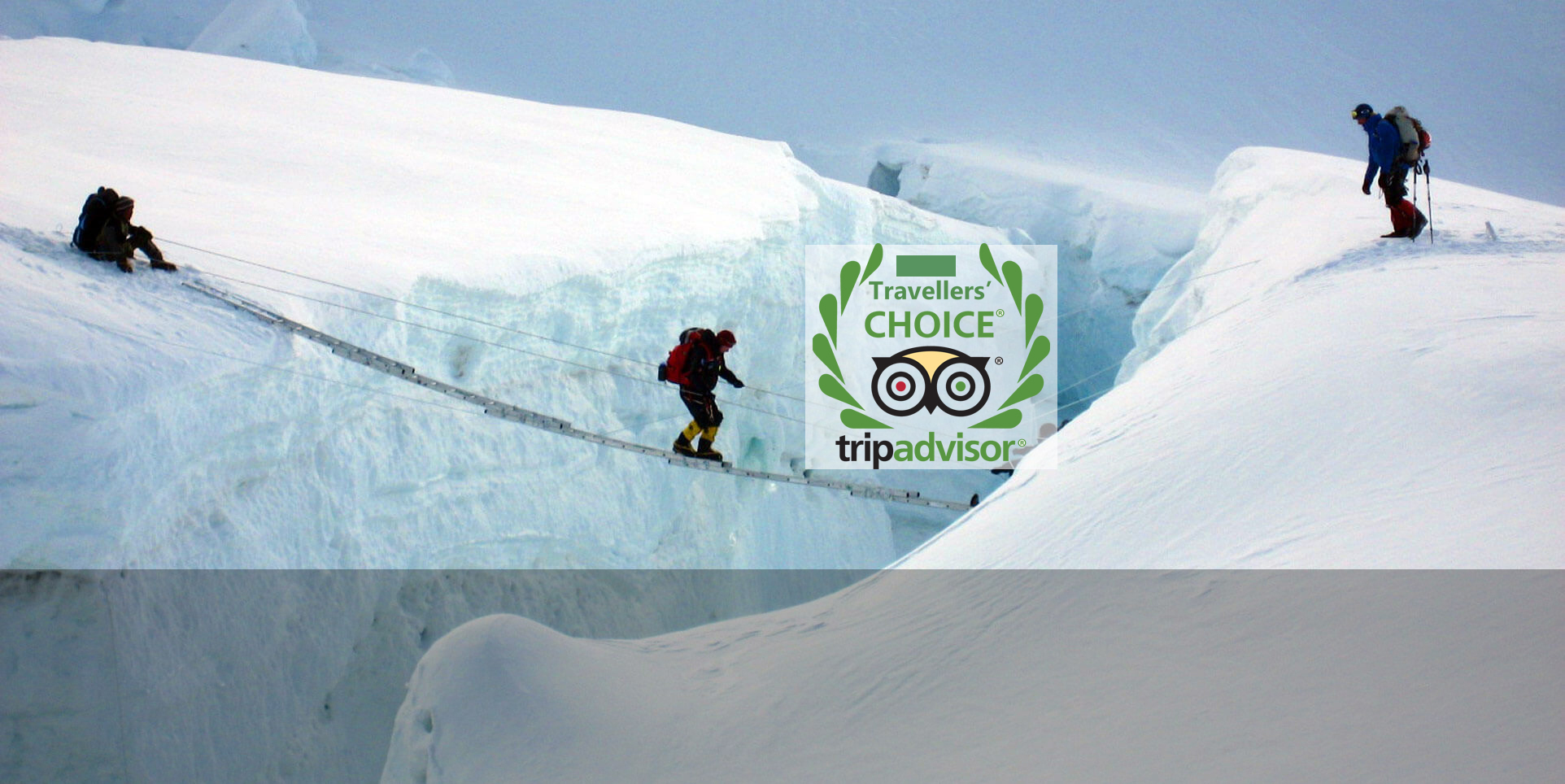
    • Sherpas: We have many group sherpas to help the team. For an additional expense, we can also provide personal sherpas and climbing-guides to individual members who wish to have their own private sherpa. We now encourage members who wish to have a lighter rucksack to hire a 1/4 of a sherpa to help with high altitude equipment transport, carrying your extra weight both up and down the mountain. For information about hiring a personal sherpa, please click here (photo above right by Bruce Manning: Team members crossing a ladder over a deep crevasse in the interesting Khumbu Icefall. Rope and ladders are expertly fixed and maintained through the maze of shifting glacial seracs). back to top
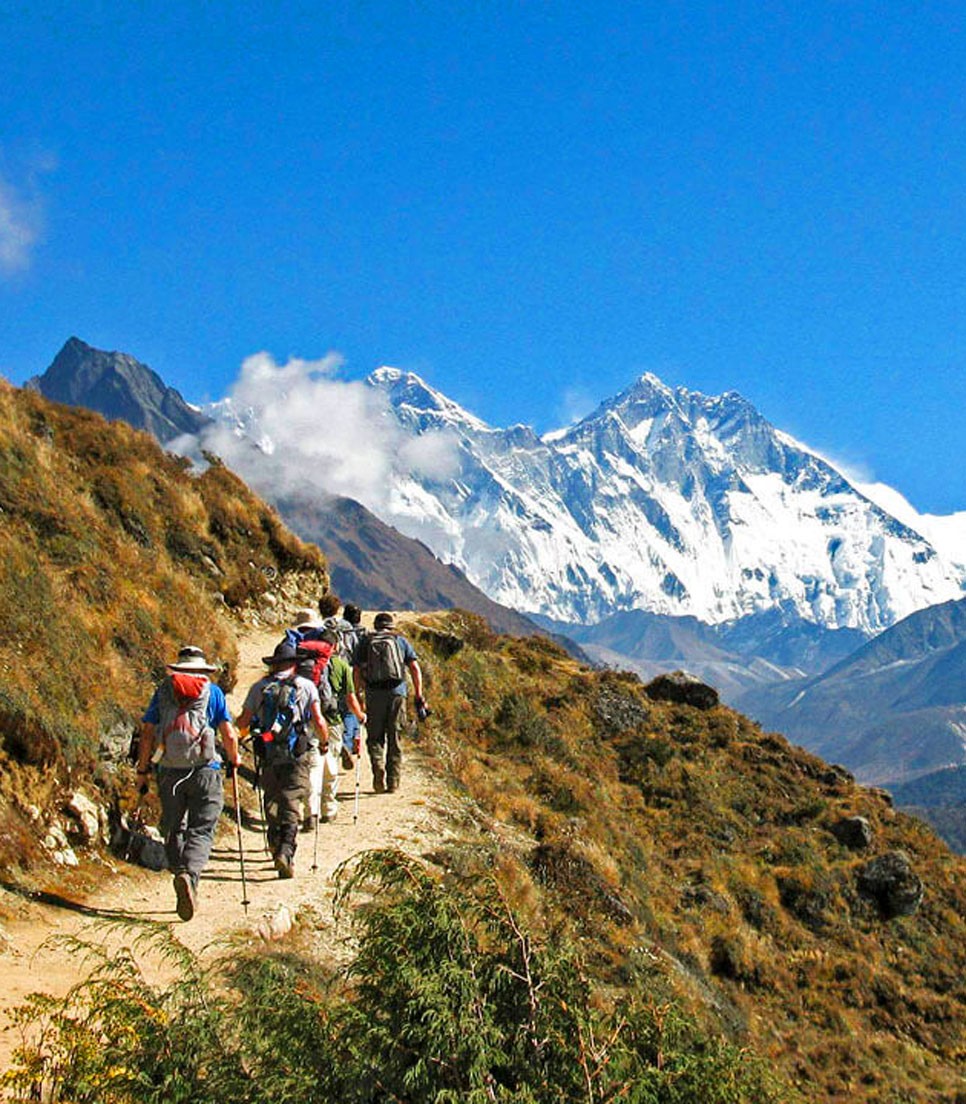
  • Everest National Park: The park (where Lhotse is located) covers an area of 1148 square kilometres in the Khumbu region of Nepal. This includes Lhotse and several other well known peaks such as Everest, Pumori, Island Peak , and Ama Dablam. The surrounding area is a 'world biosphere reserve'. Since 1976 the park has served to safeguard unique cultural, physical and scientific values through sound conservation principles. Vegetation in the park varies from oak, pine and hemlock forests at lower altitudes to fir, juniper, birch and rhododendron woods at mid-elevations. Scrub and alpine plant communities with bare rock and glacier are found above the tree line. 22 species of rhododendron bloom during the spring (April and May) and much of the flora is colourful throughout the year. Wild animals most likely to be seen in the park are Himalayan tahr, goral, serow, musk deer, and well over 100 different bird species (photo right by Bruce Manning: Our Lhotse expedition features one of the most breathtaking treks in the world, included in the price). back to top
  • Trek to basecamp: This is one of the most beautiful treks in the world with ancient snow-free paths winding past green terraced villages, rushing streams crossed on swinging bridges and each night a comfortable 'teahouse' or a good tent pitched in a quiet pasture beneath the highest peaks in the world. Throughout the trek we eat delicious meals prepared by our skillful cooks. The trek will be moderately paced, allowing plenty of time for acclimatization, rest and site-seeing. Together we retrace the classic "Everest Approach March" made by Hillary and Tenzing Norgay Sherpa. The trek winds through some of the most spectacular mountain scenery on earth, where you can relax in exotic, friendly Sherpa villages. Our trusty yaks and porters carry all of your baggage, so you don't have to carry a heavy rucksack.
  • Basecamp: Features your own private sleeping tent that will be all your own, not needing to be shared with anyone. We have comfortable, heated dining tents with tables and chairs where our cooks and waiters will serve you delicious meals.
  • Climbing to the high camps:
    • Above basecamp: Clip in to the fixed lines to head through the awe-inspiring Khumbu Icefall up to the plateau of the Western Cwm and camp 1, at 5,800 metres/19,000 feet.
    • From camp 1: The route traverses the flattish bottom of the Western Cwm, to 6,200 metres/20,300 feet to camp 2.
    • Camp 2: Located on a rocky moraine below the awe-inspiring west-face of Everest. In camp 2 our sherpa cook will prepare hot meals and drinks.
    • Camp 3: Located on a flat-ish section protected by solid ice walls at about 7,200 metres/23,600 feet on the Lhotse face. To reach camp 3, we must negotiate the Lhotse Face. The Lhotse face is not very technical, in fact, after climbing the initial 38-65 degree 100 metre/300 foot high ramp, the average slope angle of the entire 'face' is around 30 degrees.
    • Camp 4: Located upon rock shelves on the upper Lhotse face. It is the highest camp at 7850 metres/25,700 feet, and can be an airy perch for the few days we reside there (photo right by Bruce Manning: Camp 4 at 7850 metres/25,700 feet on the upper Lhotse face).
  • Rest Days: We will be taking a lot of them throughout the expedition. In fact, we might even descend to a lower village for three-four days to soak up the sunshine and thicker air before our final summit push. During your rest days we encourage you to concentrate on recovering, eating and drinking, to read, relax, listen to music and stroll around visiting other teams. back to top
  • Summit attempt: The route to the summit climbs the upper Lhotse face into the Lhotse couloir, tilted at a 25-55 degree angle. The final summit "gully" is a couloir which is often filled with snow, patches of ice and sometimes rock. The couloir ends and the final 100 metres mounts a "summit block" of steps and snow. In the past couple of years we have fixed rope all the way to the summit.
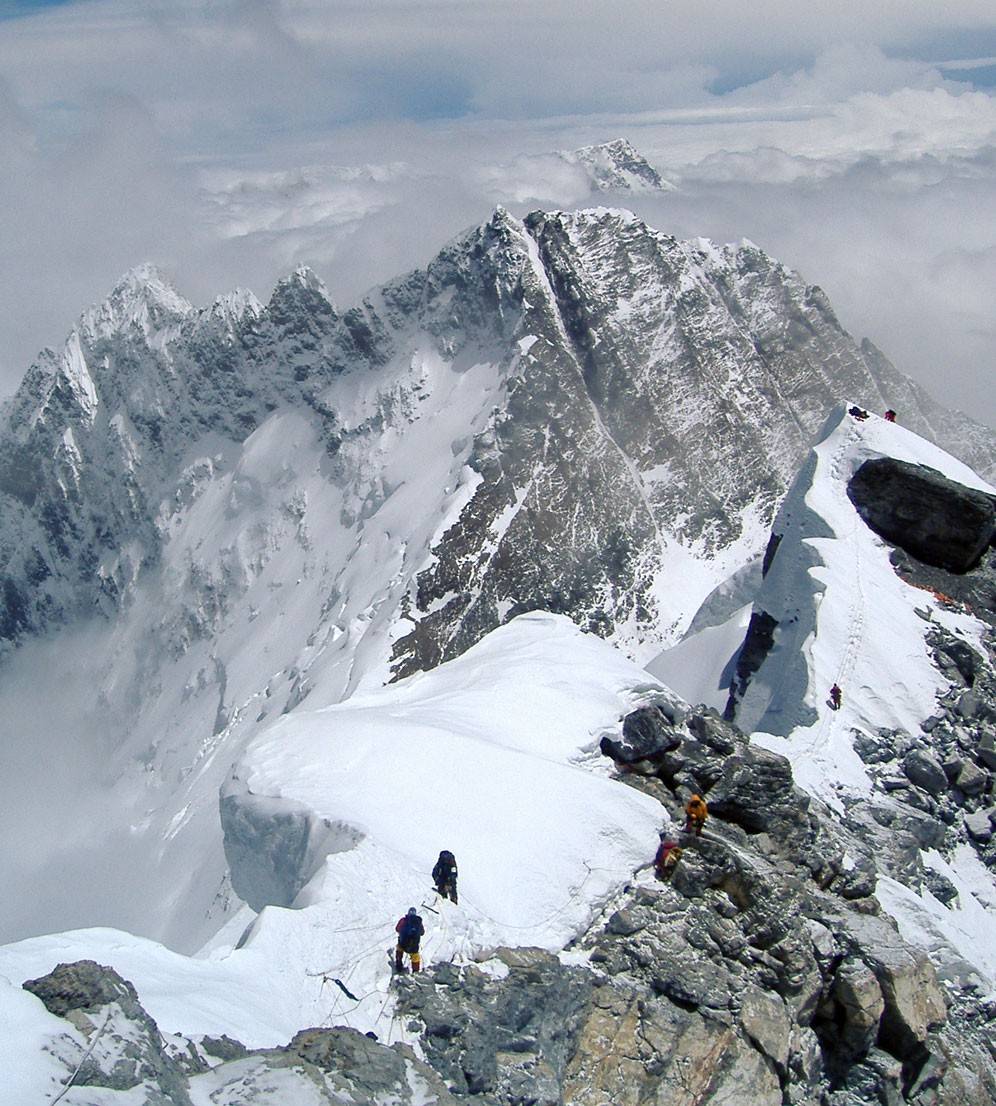
Climbing up into the Lhotse couloir from 8000 metres/26,000 feet on a sunny day (Tunc Findik). Our team member Bruce on the summit of Lhotse with Everest behind him (Bruce Manning).
  • Who is this trip for?
    • We encourage men and women from around the world, of all ages to join us as an individual team member or with your own group, whether that is your spouse, partner, friends, sibling, clients, colleagues, etc. Most of our members join as individuals, our team dynamics work well, and we are able to build successful and safe groups that enjoy trekking, climbing, and traveling together.
    • You should have previous high altitude climbing experience (such as Cho Oyu Shishapangma, Everest, Mustagata, Ama Dablam, Denali, Aconcagua, Lhakpa Ri / North Col or other. For Lhotse you need to be competent with ice-axe and crampons (photo right by Bruce Manning: The view from the summit south to the other tops of Lhotse, looking as if they might be as high as the summit we are standing on).
    • To participate in this expedition you must be a very fit and active winter-walker-climber in good health. Prior to joining, please see your doctor and obtain the necessary permission and advice. back to top
Please "click" one of the links on the column on the upper right of your screen under "Lhotse" to learn more about our expedition.